
Two former U.S. senators for governor, and a long ballot below them.
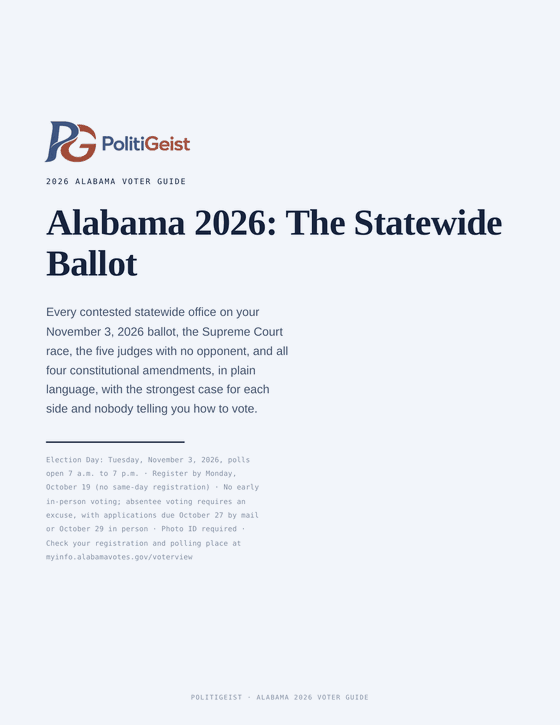
Every contested statewide office on your November 3, 2026 Alabama ballot, from Doug Jones against Tommy Tuberville for governor to both Public Service Commission seats, plus the Supreme Court race, the five unopposed judges, and all four constitutional amendments, in plain language and with nobody telling you how to vote.
- Both sides, no spin
- Straight-party trap explained
- Sourced & cited
- Instant PDF download
The strongest case for each side
For every contested race, the Supreme Court seat, and all four amendments, the best honest argument each way. Equal space, no endorsement.
The straight-party trap
Alabama's straight-party oval doesn't vote on the four amendments, and in the five judicial races with only a Republican, a Democratic straight-party vote casts nothing. We show you where it stops working.
Two residency lawsuits, laid out
Lawsuits challenge the residency of Tommy Tuberville and John Wahl, the Republican nominees for governor and lieutenant governor. We lay out where each case stands without predicting how either ends.
Sourced, not spun
Every factual claim is tied to reporting and official records, listed at the back.
What's inside
Ten contested statewide races, six judicial seats, and four amendments.
Governor
Doug Jones against Tommy Tuberville, a rematch of their 2020 Senate race, with Kay Ivey term-limited out.
U.S. Senate
U.S. Rep. Barry Moore against Birmingham attorney Everett Wess, for the seat Tuberville is leaving.
Lieutenant Governor
State Rep. Phillip Ensler against former state GOP chair John Wahl, whose residency is being challenged in court.
Attorney General
Deputy attorney general Katherine Robertson against former legislator Jeff McLaughlin, with Steve Marshall term-limited.
Secretary of State
Caroleene Dobson against Wayne Rogers for the office that runs elections, in a state with no early voting.
State Treasurer
Young Boozer, treasurer for most of the last fifteen years, against banking executive Rosilyn Houston.
State Auditor
Andrew Sorrell against Violet Edwards, for an office that, despite the title, doesn't audit the state's books.
Agriculture & Industries
Former commissioner Ron Sparks against Corey Hill, a farmer and the mayor of Douglas.
Public Service Commission
Both elected seats on the utility regulator, which is barred from formal rate-case hearings until 2029.
Supreme Court, Place 8
Justice Greg Shaw against Ashleigh Meyer Dunham, the only contested statewide judicial race this year.
Five unopposed judges
Who's on the ballot for the five appellate seats with a single candidate, and what a straight-party vote does there.
Amendments 1 to 4
Lieutenant governor vacancies, merging school systems, the Pledge and student-led prayer, and a weekly national anthem.
Get the full 2026 Alabama Voter Guide
Ten contested statewide races, six judicial seats, and all four amendments. Instant PDF download.
Get the guide · $9.99What format is it?
A PDF you download the moment you buy. Read it on your phone or computer, or print it to take to the polls.
Is it partisan?
No. PolitiGeist is independent and makes no endorsement in any race or on any amendment. The point is the strongest case for both sides.
What does it cover?
Governor, U.S. Senate, Lieutenant Governor, Attorney General, Secretary of State, Treasurer, Auditor, Commissioner of Agriculture and Industries, both Public Service Commission seats, Supreme Court Place 8, the five unopposed appellate judges, and Amendments 1 through 4. U.S. House, legislative, and local races aren't included.
What's the straight-party trap?
Alabama lets you fill one oval to vote for every Democrat or every Republican. That oval doesn't vote on the four amendments, which need their own YES or NO, and in the five judicial races with only a Republican on the ballot, a Democratic straight-party vote casts nothing. Mark a candidate from the other party in any race and that individual mark wins there.