
Mitch McConnell's seat is open for the first time in four decades.
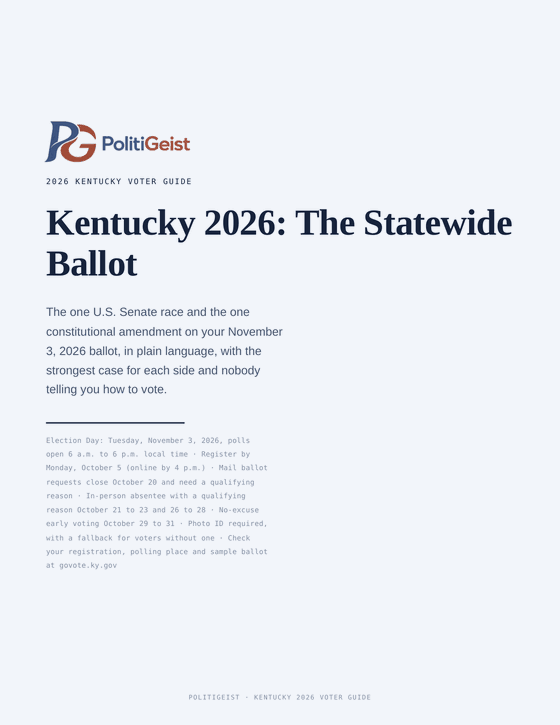
Kentucky's statewide ballot is short this year: Andy Barr against Charles Booker for the open U.S. Senate seat, and Amendment 1, on limiting a governor's pardons around an election. Here it is in plain language, with nobody telling you how to vote.
- Both sides, no spin
- Amendment 1 explained
- Sourced & cited
- Instant PDF download
The strongest case for each side
For the Senate race and Amendment 1, the best honest argument each way. Equal space, no endorsement.
Straight-ticket won't vote on Amendment 1
Kentucky still offers a straight-ticket button, but it skips the amendment and the nonpartisan judicial races. Mark those yourself.
Polls from one campaign only
The only published general-election polls were paid for by Booker's campaign. We say so up front and give you the race, not the horserace.
Sourced, not spun
Every factual claim is tied to reporting and official records, listed at the back.
What's inside
One U.S. Senate race and one constitutional amendment.
U.S. Senate
U.S. Rep. Andy Barr against former state Rep. Charles Booker, for the seat Mitch McConnell is leaving.
Amendment 1: Pardon Limits
Whether a governor loses the power to pardon from 60 days before an election until the new governor is sworn in.
Before you vote
Registration, the qualifying-reason rules for absentee voting, no-excuse early voting October 29 to 31, and photo ID.
Get the full 2026 Kentucky Voter Guide
The Senate race and Amendment 1. Instant PDF download.
Get the guide · $3.99What format is it?
A PDF you download the moment you buy. Read it on your phone or computer, or print it to take to the polls.
Is it partisan?
No. PolitiGeist is independent and makes no endorsement in any race or on the amendment. The point is the strongest case for each side.
What does it cover?
The open U.S. Senate race and Amendment 1. Kentucky elects its governor and other statewide officers in odd-numbered years, next in 2027, and the only Supreme Court seat up this year is a regional one with a single candidate. U.S. House, legislative, and local races aren't included.
Why is Kentucky cheaper than other states?
Because the statewide ballot is genuinely shorter. Pricing follows how much is actually on it, not a flat rate per state.