
Two former statewide officeholders, four court seats, and three amendments.
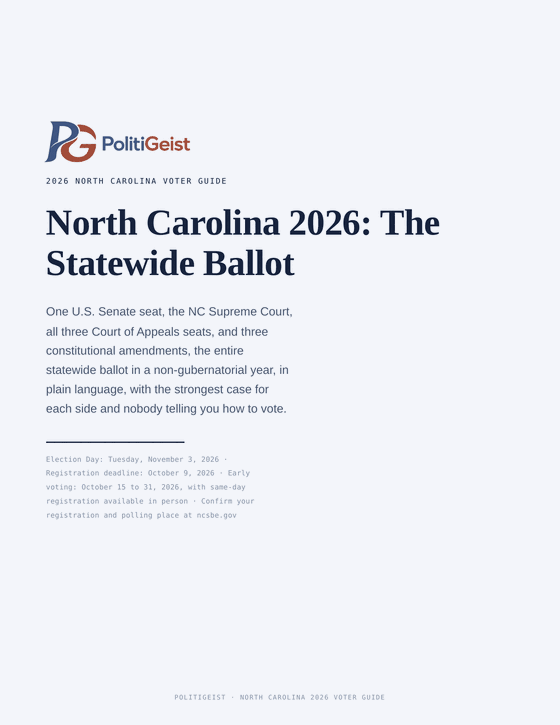
North Carolina elects no governor this year, so the whole statewide ballot is the open Senate seat, four appellate court seats, and three constitutional amendments, in plain language and with nobody telling you how to vote.
- Both sides, no spin
- All three amendments
- Sourced & cited
- Instant PDF download
The strongest case for each side
For every race and every amendment, the best honest argument each way. Equal space, no endorsement.
Judges appear with party labels here
North Carolina has put party labels on judicial candidates since 2018, and voters still get surprised by it. The guide explains what the label does and does not tell you.
Amendments outlast whoever wins
Voter ID, an income tax rate cap, and property tax levy limits are constitutional changes, far harder to undo than any statute. Each gets the case both ways.
Sourced, not spun
Every factual claim is tied to reporting and official records, listed at the back.
What's inside
The Senate seat, four court seats, and Amendments 1 through 3.
U.S. Senate
Former Gov. Roy Cooper against former RNC chair Michael Whatley, after Thom Tillis stepped aside.
NC Supreme Court, Seat 1
Justice Anita Earls against state Rep. Sarah Stevens, on a court that is 12-3 in one direction.
NC Court of Appeals
All three seats up are held by the court's only Democrats, in one grid with a case each way.
Amendment 1
Writing a voter identification requirement into the constitution.
Amendment 2
A lower cap on the state income tax rate.
Amendment 3
New limits on how much local governments can levy in property taxes.
Before you vote
Registration, early voting, ID rules, and Election Day.
Get the full 2026 North Carolina Voter Guide
The Senate seat, four court seats, and all three amendments. Instant PDF download.
Get the guide · $7.99What format is it?
A PDF you download the moment you buy. Read it on your phone or computer, or print it to take to the polls.
Is it partisan?
No. PolitiGeist is independent and makes no endorsement in any race or on any amendment. The point is the strongest case for both sides.
What does it cover?
U.S. Senate, NC Supreme Court Seat 1, all three NC Court of Appeals seats on the ballot, and Amendments 1, 2, and 3. North Carolina elects no governor or other council of state office in 2026, and U.S. House, legislative, and local races aren't included.
Why do judges have party labels?
Because state law has required them on judicial ballots since 2018. The guide explains what that label reflects and what it doesn't, so you can read the court section without treating it as a party vote.