One statewide vote, and mail-ballot rules worth reading twice.
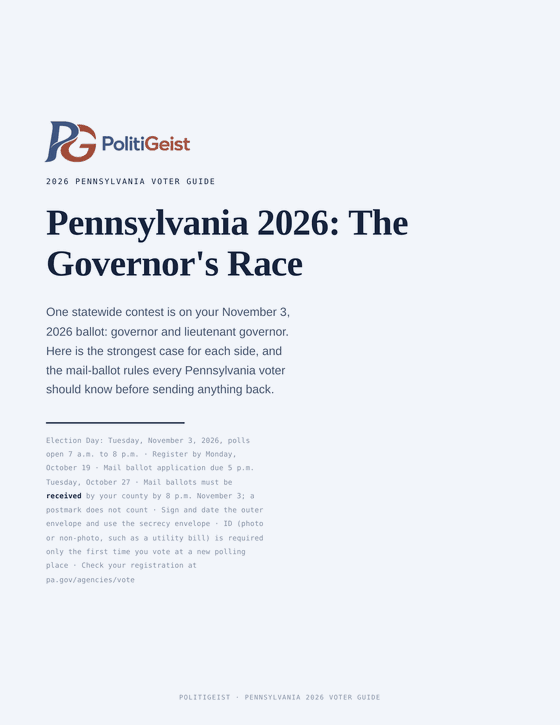
Pennsylvania's statewide ballot is one race this year: Josh Shapiro against Stacy Garrity for governor and lieutenant governor, with a Libertarian ticket also on the ballot. Here it is in plain language, plus the mail-ballot rules every voter should know, with nobody telling you how to vote.
- Both sides, no spin
- Mail-ballot rules explained
- Sourced & cited
- Instant PDF download
The strongest case for each side
For the governor's race, the best honest argument each way. Equal space, no endorsement.
The mail-ballot date fight
A federal appeals court has ruled that counties can't reject a timely ballot over a missing or wrong date, and the U.S. Supreme Court hasn't yet decided whether to take the case. We explain what that means for your envelope.
Why your ballot is so short
No U.S. Senate race, no other statewide office, no judges, and no statewide questions this year. We explain why each one is missing.
Sourced, not spun
Every factual claim is tied to reporting and official records, listed at the back.
What's inside
Pennsylvania's one statewide race, and how to cast your ballot.
Governor & Lieutenant Governor
Josh Shapiro and Austin Davis against Stacy Garrity and Jason Richey, with a Libertarian ticket also on the ballot.
Mail ballots
The secrecy envelope, dating the outer envelope, the 8 p.m. receipt deadline, and what to do if your ballot is rejected.
Get the full 2026 Pennsylvania Voter Guide
The governor's race and the mail-ballot rules. Instant PDF download.
Get the guide · $3.99What format is it?
A PDF you download the moment you buy. Read it on your phone or computer, or print it to take to the polls.
Is it partisan?
No. PolitiGeist is independent and makes no endorsement. The point is the strongest case for each side.
What does it cover?
Governor and Lieutenant Governor, Pennsylvania's only statewide contest in 2026, plus the mail-ballot rules. There's no U.S. Senate race this year, the other statewide offices were last elected in 2024, judges are elected in odd-numbered years, and there are no statewide ballot questions. U.S. House, legislative, and local races aren't included.
Why is Pennsylvania cheaper than other states?
Because there is one statewide race on the ballot. Pricing follows how much is actually on it, not a flat rate per state.