
No statewide candidates this year. Seven judges and two amendments instead.
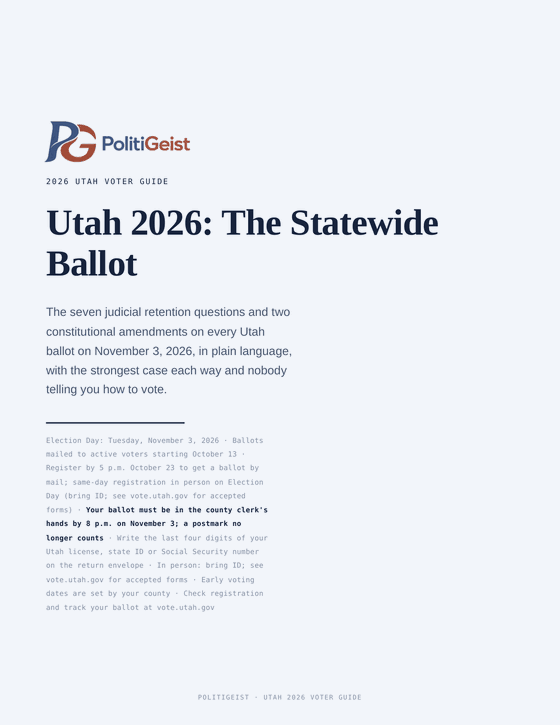
Utah's statewide ballot is short this year: retention votes for Supreme Court Justice Jill M. Pohlman and six Court of Appeals judges, and Constitutional Amendments A and B. Here it is in plain language, with nobody telling you how to vote.
- Both sides, no spin
- Mail-ballot deadline explained
- Sourced & cited
- Instant PDF download
The strongest case for each side
For the retention fight and both amendments, the best honest argument each way. Equal space, no endorsement.
The postmark no longer counts
A new law ended the grace period. Your ballot must reach the county clerk by 8 p.m. on November 3, so in the last week, use a drop box.
The one contested retention vote
The Utah Republican Party chair urged a no on Justice Pohlman over a 2024 ruling, and the state Bar pushed back. We give both sides.
Sourced, not spun
Every factual claim is tied to reporting and official records, listed at the back.
What's inside
Seven judicial retention questions and two constitutional amendments.
Justice Jill M. Pohlman
The most contested vote on the ballot, over a 2024 ruling on the Legislature's power over initiatives.
Court of Appeals
Six judges, each a yes-or-no question, and where to find their evaluations.
Amendment A
Replacing newspaper notice of proposed amendments with 60 days of publication set by state law.
Amendment B
A 60% vote for any citizen initiative that raises taxes.
Get the full 2026 Utah Voter Guide
Seven retention questions and both amendments. Instant PDF download.
Get the guide · $3.99What format is it?
A PDF you download the moment you buy. Read it on your phone or computer, or print it to take to the polls.
Is it partisan?
No. PolitiGeist is independent and makes no endorsement on any retention question or on either amendment. The point is the strongest case each way.
What does it cover?
Retention questions for Supreme Court Justice Jill M. Pohlman and six Court of Appeals judges, and Amendments A and B. There's no U.S. Senate race, and the governor and other statewide offices are next elected in 2028. District and justice court retention, U.S. House, legislative, and local races aren't included.
Why is Utah cheaper than other states?
Because the statewide ballot is genuinely shorter. Pricing follows how much is actually on it, not a flat rate per state.