
One Senate race. One amendment. Nothing padded.
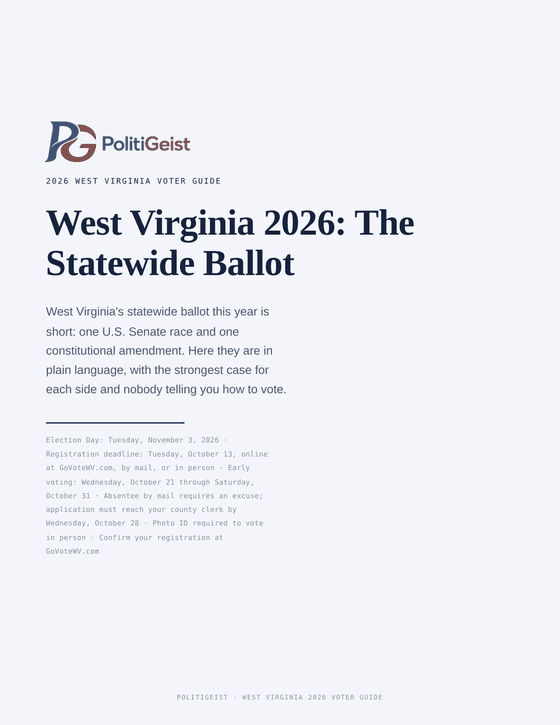
West Virginia's statewide ballot is short this year: Shelley Moore Capito against Rachel Fetty Anderson for U.S. Senate, and Amendment 1, on writing a citizenship requirement to vote into the state constitution. Here it is in plain language, with nobody telling you how to vote.
- Both sides, no spin
- Amendment 1 explained
- Sourced & cited
- Instant PDF download
The strongest case for each side
For the Senate race and the amendment, the best honest argument each way. Equal space, no endorsement.
What Amendment 1 actually changes
Noncitizens already can't vote in West Virginia. We explain what the amendment would change, and why supporters and opponents both say it matters.
Thin coverage, disclosed
The challengers have raised little and drawn little coverage. We say so plainly instead of inventing detail.
Sourced, not spun
Every factual claim is tied to reporting and official records, listed at the back.
What's inside
One U.S. Senate race and one constitutional amendment.
U.S. Senate
Shelley Moore Capito seeks a third term against Morgantown attorney Rachel Fetty Anderson.
Amendment 1: Citizenship Requirement to Vote
Whether to write a U.S.-citizenship requirement to vote into the state constitution.
Before you vote
Registration, early voting, excuse-only absentee voting, photo ID, and why the court races are already decided.
Get the full 2026 West Virginia Voter Guide
The Senate race and Amendment 1. Instant PDF download.
Get the guide · $3.99What format is it?
A PDF you download the moment you buy. Read it on your phone or computer, or print it to take to the polls.
Is it partisan?
No. PolitiGeist is independent and makes no endorsement in any race or on the amendment. The point is the strongest case for each side.
What does it cover?
The U.S. Senate race and Amendment 1. West Virginia's executive offices are next elected in 2028, and its court races were decided at the May 12 nonpartisan election. U.S. House, legislative, and local races aren't included.
Why is West Virginia cheaper than other states?
Because the statewide ballot is genuinely shorter. Pricing follows how much is actually on it, not a flat rate per state.